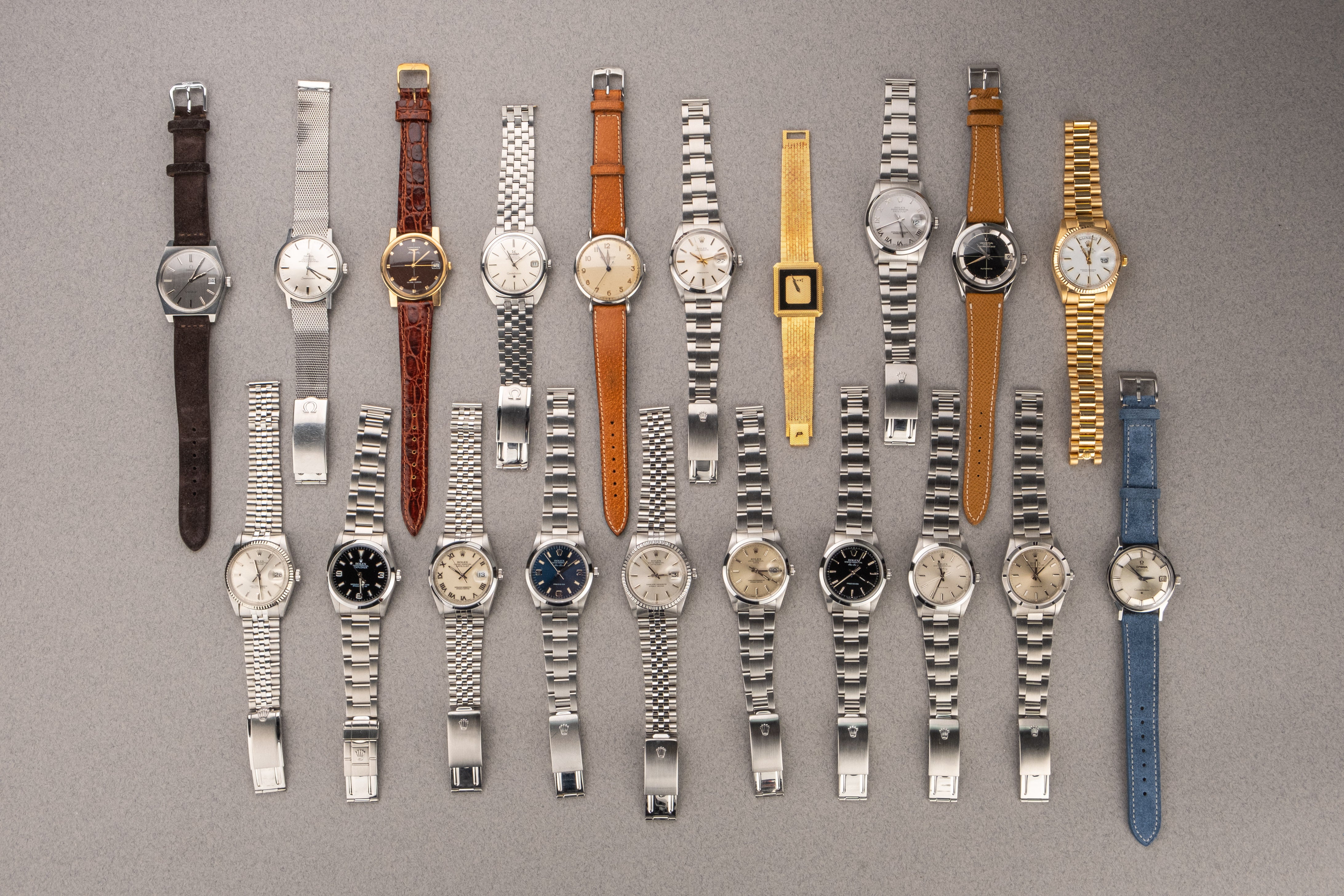
Omega Serial Numbers: How to Identify Your Watch’s Production Year
Vintage Omega watches are identifiable by a 5–9 digit serial number, engraved on the movement, which allows their year of production to be estimated. Unlike Rolex, Omega has never published an official correspondence table: the boundaries used by collectors and dealers have been reconstructed from the observation of countless watches dated by their original papers. Accuracy is generally ± 1 to 2 years, and sometimes more for pieces predating 1950.
Note: Speedmaster watches have their own numbering, distinct from other Omega watches. This page covers Omega watches excluding Speedmaster. The dedicated Speedmaster table is in preparation.
Where to find the serial number on your Omega
Unlike Rolex, Omega has never engraved its serial number between the lugs. The location varies depending on the watch’s era of production.

On the movement
On Vintage Omega watches, the serial number is engraved only on the movement — generally on the mainplate, near the balance wheel. It is not visible from the outside: the case back must be opened (by unscrewing or prying open with a blade, depending on the model) to read it. This operation should ideally be entrusted to a watchmaker to avoid risk of marking the case.

On the back of one of the lugs
On Neo-Vintage and modern Omega watches, the serial number is engraved on the back of one of the lugs, on the outer edge of the case. It is generally readable directly, without having to remove the bracelet or open the case. The model’s reference number is often found on the opposite lug.
Table of Omega serial numbers by year (excluding Speedmaster)
This table covers Omega watches excluding Speedmaster. It is consolidated from the main reference sources recognised by collectors (Bobs Watches, Vintage Masters, OmegaForums, etc.). Since Omega has never published an official table, an accuracy of ± 1 to 2 years should be expected, and more for pieces predating 1950. The date of the movement is moreover not necessarily the date of casing nor that of the sale — a movement could be stored for several years before being cased.
Avant 1944 — précision approximative (± 2 ans)
Pour cette première période, les sources divergent fréquemment de 1 à 3 ans. Les bornes ci-dessous correspondent à un consensus large entre les principales tables de référence.
| Année | Numéro de série (à partir de) |
|---|---|
| 1894 | 1 000 000 |
| 1902 | 2 000 000 |
| 1906 | 3 000 000 |
| 1910 | 4 000 000 |
| 1915 | 5 000 000 |
| 1923 | 6 000 000 |
| 1929 | 7 000 000 |
| 1934 | 8 000 000 |
| 1939 | 9 000 000 |
| 1944 | 10 000 000 |
1944 — 1985 — précision standard (± 1 an)
| Année | Numéro de série |
|---|---|
| 1944 | 10 000 000 — 10 999 999 |
| 1947 | 11 000 000 — 11 999 999 |
| 1950 | 12 000 000 — 12 999 999 |
| 1952 | 13 000 000 — 13 999 999 |
| 1954 | 14 000 000 — 14 999 999 |
| 1956 | 15 000 000 — 15 999 999 |
| 1958 | 16 000 000 — 16 999 999 |
| 1959 | 17 000 000 — 17 999 999 |
| 1961 | 18 000 000 — 18 999 999 |
| 1962 | 19 000 000 — 19 999 999 |
| 1963 | 20 000 000 — 20 999 999 |
| 1964 | 21 000 000 — 21 999 999 |
| 1965 | 22 000 000 — 22 999 999 |
| 1966 | 23 000 000 — 24 999 999 |
| 1967 | 25 000 000 — 25 999 999 |
| 1968 | 26 000 000 — 27 999 999 |
| 1969 | 28 000 000 — 31 999 999 |
| 1970 | 32 000 000 — 32 999 999 |
| 1971 | 33 000 000 — 33 999 999 |
| 1972 | 34 000 000 — 35 999 999 |
| 1973 | 36 000 000 — 37 999 999 |
| 1974 | 38 000 000 — 38 999 999 |
| 1975 — 1976 | 39 000 000 — 39 999 999 |
| 1977 | 40 000 000 — 40 999 999 |
| 1978 | 41 000 000 — 41 999 999 |
| 1979 — 1980 | 42 000 000 — 44 999 999 |
| 1982 — 1983 | 45 000 000 — 45 999 999 |
| 1984 | 46 000 000 — 47 999 999 |
| 1985 | 48 000 000 — 48 999 999 |
Particularité : certaines années (1981, 1983, 1987-1988, 1990, 1992, 1994, 1996-1997) ne sont attribuées à aucune tranche d'1 million dédiée. Ce phénomène vient probablement de l'utilisation simultanée de plusieurs séries de numérotation par Omega, ou de réutilisations partielles. Pour ces années, le seul numéro de série ne suffit pas : il faut croiser avec la référence du modèle, le calibre et les papiers d'origine.
1986 — 2008 — numérotation tardive
| Année | Numéro de série |
|---|---|
| 1986 | 49 000 000 — 50 999 999 |
| 1989 | 51 000 000 — 51 999 999 |
| Non utilisé ⚠ | 52 000 000 — 52 999 999 |
| 1991 | 53 000 000 — 53 999 999 |
| 1993 | 54 000 000 — 54 999 999 |
| 1995 | 55 000 000 — 55 999 999 |
| 1998 | 56 000 000 — 59 999 999 |
| 1999 | 60 000 000 — 60 999 999 |
| 2000 | 61 000 000 — 64 999 999 |
| 2001 | 65 000 000 — 65 999 999 |
| 2002 | 66 000 000 — 67 999 999 |
| 2003 | 68 000 000 — 69 999 999 |
| 2004 | 70 000 000 — 71 999 999 |
| 2005 | 72 000 000 — 77 999 999 |
| 2006 | 78 000 000 — 80 999 999 |
| 2007 | 81 000 000 — 83 999 999 |
| 2008 et après | 84 000 000 et au-delà |
52 000 000 — Non utilisé : la tranche allant de 52 000 000 à 52 999 999 n'a jamais été attribuée par Omega à des montres de production. La cause exacte n'a jamais été communiquée par la marque ; il s'agit d'une rupture documentée par la communauté des collectionneurs. Toute Omega présentant un numéro de série dans cette plage doit faire l'objet d'une expertise approfondie.
Après 2008 — changement de système
À partir de la fin des années 2000, Omega a progressivement abandonné le système de numérotation séquentielle au profit d'une double identification : un numéro de série à 8 chiffres (gravé sur le mouvement) et une référence à 14 chiffres au format XX.XX.XXXX.XX.XXX.XXX (gravée à l'arrière d'une des cornes), qui décrit précisément le modèle, le calibre, le matériau du boîtier, le type de bracelet et le cadran. Avec ce nouveau système, le numéro de série seul ne permet plus de déduire l'année de production : il faut croiser avec la référence, la carte de garantie et les caractéristiques du modèle.
Frequently asked questions
Serial number versus reference number: what’s the difference?
The two numbers are distinct and complementary:
- The reference number identifies the model: it describes the calibre, the case, the dial and the bracelet. All watches sharing the same reference are identical. On a Vintage Omega, the reference is most often found on the inside of the case back, in the form “2638-1” or “CK 2998” for example. On a modern Omega, it is engraved on the back of one of the lugs in the 14-digit format “XX.XX.XXXX.XX.XXX.XXX”.
- The serial number is unique to each piece produced. It allows the year of production to be estimated. On Vintage Omega watches, it is engraved on the movement.
To date a watch precisely and verify its consistency, both numbers are necessary.
Does the table give the exact year of production?
No, accuracy is typically ± 1 to 2 years, and more for pieces predating 1950 (up to ± 3 years). Omega has never published an official table: all available correspondences have been reconstructed by the community of collectors and dealers from the observation of countless watches dated by their original papers. Furthermore, the serial number indicates the year of production of the movement, which could be stored for several years before being cased and sold — a gap of several years between the serial number and the actual casing date is not exceptional on very old pieces.
My Omega is recent and its serial number does not appear in the table. How can I date it?
Beginning in the late 2000s, Omega progressively abandoned sequential numbering in favour of a dual identification: the 8-digit movement serial number and the 14-digit reference in the format “XX.XX.XXXX.XX.XXX.XXX”, engraved on the back of one of the lugs. With this new system, the serial number alone no longer allows the year to be deduced. To date a recent Omega, you must cross-reference:
- The 14-digit reference and its year of commercial introduction
- The original Omega warranty card (date of purchase)
- The characteristics of the dial (variants, certifications)
Does this table work for Speedmaster watches?
No. Speedmaster watches use numbering distinct from other Omega watches, with significantly different boundaries. This page only covers Omega watches excluding Speedmaster (Constellation, Seamaster, De Ville, Geneve, Memomatic, non-Speedmaster Flightmaster, etc.). A dedicated Speedmaster page is in preparation.
What is an Omega “Extract from the Archives”?
The Extract of the Archives (Omega’s official term — not to be confused with Patek Philippe’s Extract from the Archives) is a document historically issued by Omega Geneva, based on a serial number, certifying the exact production date of a watch, its calibre, its original reference and the country to which it was shipped. It was the only authoritative source for dating purposes. Omega no longer issues these since around 2018: the programme has been suspended, then replaced for a few very specific models by the Heritage programme, access to which remains very restricted. For the majority of watches, it is no longer possible today to obtain an official certification from Omega.
Do you offer expertise and valuations?
Yes. At Amplitude°, we are specialists in Vintage and Neo-Vintage watches, Omega included. If you wish to sell your watch or have a piece valued, contact us through our dedicated form. We will reply within a few hours.