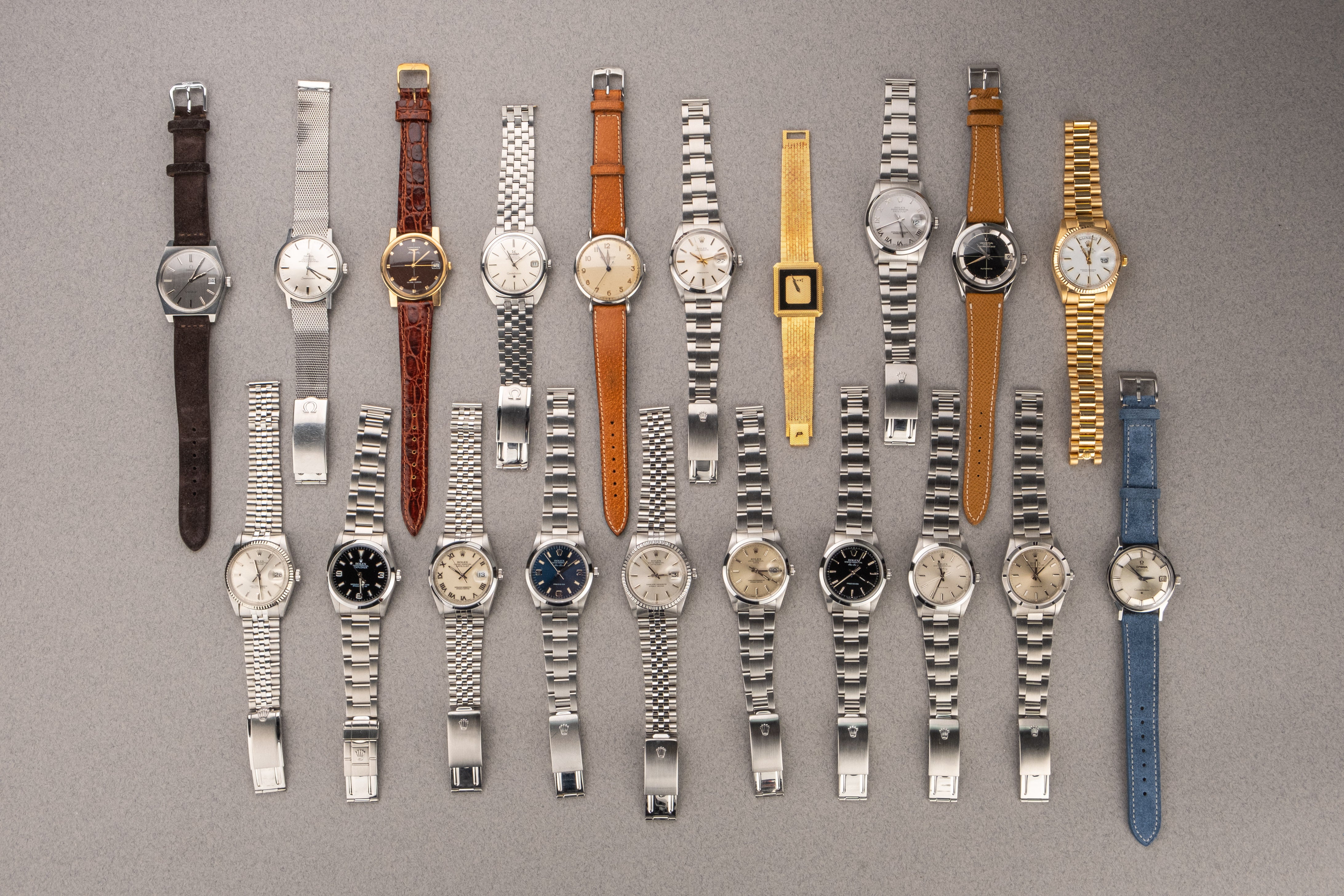
Identify the production year of your Rolex
Enter the serial number engraved on your Rolex to estimate its production year. Our tool recognises the various serial number formats used by the brand from 1926 to the present day.
Where to find the serial number on your Rolex?
The location of the serial number has evolved over the years depending on the era and the model line. On your watch, it will be found in one of these three places.

Between the lugs, at 6 o’clock
Engraved on the side of the case, between the lower lugs. Requires removing the bracelet to be read.
Transition period ~2005 — ~2008: depending on the model, also check the rehaut.

On the rehaut, at 6 o’clock
Laser-engraved on the inner ring (rehaut) at 6 o’clock, visible through the crystal without disassembling the watch. Angle the light to bring out the engraving.

On the outside of the caseback
For certain early Rolex pieces (particularly those predating the 1950s) and for the majority of models in the Cellini line, the serial number is engraved directly on the outside of the caseback. Simply turn the watch over to read it, without removing anything.
Complete Rolex serial number table by year
These serial number ranges are the result of years of study of countless watches by the collector and expert community. Rolex has never published an official table. An accuracy of ± 1 year should therefore be expected.
Numérotation séquentielle ancienne (1926 — 1954)
| Année | Plage de numéros de série |
|---|---|
| 1926 | 1 — 20 189 |
| 1927 | 20 190 — 23 968 |
| 1928 | 23 969 — 25 259 |
| 1929 | 25 260 — 26 549 |
| 1930 | 26 550 — 27 840 |
| 1931 | 27 841 — 29 131 |
| 1932 | 29 132 — 29 561 |
| 1933 | 29 562 — 30 822 |
| 1934 | 30 823 — 34 335 |
| 1935 | 34 336 — 36 855 |
| 1936 | 36 856 — 40 919 |
| 1937 | 40 920 — 43 738 |
| 1938 | 43 739 — 71 223 |
| 1939 | 71 224 — 99 774 |
| 1940 | 99 775 — 106 046 |
| 1941 | 106 047 — 143 508 |
| 1942 | 143 509 — 230 877 |
| 1943 | 230 878 — 269 560 |
| 1944 | 269 561 — 302 458 |
| 1945 | 302 459 — 367 945 |
| 1946 | 367 946 — 529 162 |
| 1947 | 529 163 — 628 839 |
| 1948 | 628 840 — 655 642 |
| 1949 | 655 643 — 682 445 |
| 1950 | 682 446 — 709 248 |
| 1951 | 709 249 — 726 638 |
| 1952 | 726 639 — 855 725 |
| 1953 | 855 726 — 999 999 (avant reset) |
« Reset de 1954 » : avant d'atteindre le millionième numéro de série, Rolex a recommencé leur numérotation, selon toute vraisemblance à partir de 23 000. Les numéros suivants peuvent donc correspondre à deux époques distinctes ⚠
Numérotation séquentielle moderne (1954 — 1987)
| Année | Plage de numéros de série | Ambiguïté |
|---|---|---|
| 1954 | 23 000 — 96 999 | Avec 1928-1939 |
| 1955 | 97 000 — 133 060 | Avec 1939-1941 |
| 1956 | 133 061 — 223 999 | Avec 1941-1942 |
| 1957 | 224 000 — 327 999 | Avec 1942-1944 |
| 1958 | 328 000 — 399 452 | Avec 1945-1946 |
| 1959 | 399 453 — 515 999 | Avec 1946 |
| 1960 | 516 000 — 643 152 | Avec 1946-1948 |
| 1961 | 643 153 — 743 999 | Avec 1948-1950 |
| 1962 | 744 000 — 823 999 | Avec 1952 |
| 1963 | 824 000 — 1 008 888 | Avec 1952-1953 |
| 1964 | 1 008 889 — 1 099 999 | — |
| 1965 | 1 100 000 — 1 199 999 | — |
| 1966 | 1 200 000 — 1 538 434 | — |
| 1967 | 1 538 435 — 1 751 999 | — |
| 1968 | 1 752 000 — 1 899 999 | — |
| 1969 | 1 900 000 — 2 241 881 | — |
| 1970 | 2 241 882 — 2 589 294 | — |
| 1971 | 2 589 295 — 2 890 458 | — |
| 1972 | 2 890 459 — 3 200 267 | — |
| 1973 | 3 200 268 — 3 567 926 | — |
| 1974 | 3 567 927 — 3 862 195 | — |
| 1975 | 3 862 196 — 4 115 298 | — |
| 1976 | 4 115 299 — ~4 360 000 | Fin de production avant gap |
| — (réservé) | ~4 360 000 — ~4 799 999 | ⚠ Carrures de service Rolex (toutes années) |
| 1977 | ~4 800 000 — 5 481 999 | Reprise après plage réservée |
| 1978 | 5 482 000 — 5 952 833 | — |
| 1979 | 5 952 834 — 6 433 999 | — |
| 1980 | 6 434 000 — 6 593 999 | — |
| 1981 | 6 594 000 — 7 129 350 | — |
| 1982 | 7 129 351 — 7 861 999 | — |
| 1983 | 7 862 000 — 8 337 999 | — |
| 1984 | 8 338 000 — 8 613 999 | — |
| 1985 | 8 614 000 — 9 289 999 | — |
| 1986 | 9 290 000 — 9 759 999 | — |
| 1987 | 9 760 000 — 9 999 999 | Transition vers le préfixe R en cours d’année |
Plage ~4 360 000 — ~4 799 999 : en 1976, Rolex a délibérément sauté de ~4,36M à ~4,8M en production. La plage intermédiaire a été réservée aux carrures de remplacement distribuées par ses Service Centers ; aucune montre n'est sortie d'usine avec un tel numéro. Concrètement : un numéro de série dans cette plage indique quasi-certainement une carrure de service (boîtier remplacé lors d'une révision officielle). Plages les plus courantes : 4,4xx,xxx et 4,7xx,xxx.
Préfixe lettre + 6 chiffres (mi-1987 — 2010)
L'ordre des lettres ne suit pas l'alphabet : la séquence « épèle » R-(O)-L-E-X puis continue de manière non séquentielle. Les transitions ont le plus souvent lieu en cours d'année.
| Préfixe | Années |
|---|---|
| R | 1987 — 1988 |
| L | 1989 |
| E | 1990 — 1991 |
| X | 1991 |
| N | 1991 — 1992 |
| C | 1992 |
| S | 1993 — 1994 |
| W | 1995 |
| T | 1996 |
| U | 1997 — 1998 |
| A | 1999 — 2000 |
| P | 2000 — 2001 |
| K | 2001 — 2002 |
| Y | 2002 — 2003 |
| F | 2003 — 2005 |
| D | 2005 — 2006 |
| Z | 2006 — 2007 |
| M | 2007 — 2008 |
| V | 2008 — 2010 |
| G | 2010 (dernier préfixe) |
Numéros aléatoires (mi-2010 — aujourd'hui)
Depuis mi-2010, Rolex utilise des numéros de série aléatoires de 8 caractères alphanumériques (ex. K25L9413, F629478V). Ces numéros sont volontairement non séquentiels : il est impossible de déduire l'année de production à partir du seul numéro. Pour dater une montre récente, croisez avec le code de fermoir, la carte de garantie, ou la référence du modèle.
Rolex clasp/buckle codes ("clasp codes")
The date code on a Rolex bracelet’s deployant clasp is engraved on the inside of the clasp hinge, or sometimes on the end-link (the first link of the bracelet, which attaches to the case). It is useful for dating certain Rolex pieces produced after 2010, whose serial number is random, but also useful as a cross-reference for older models. Thus, a Rolex produced in 1983, for example, that has retained its bracelet stamped "H" (which corresponds to production also in 1983), holds an additional appeal for collectors.
Format du code
- 1956 — 1972 : Deux chiffres (par exemple, 64 pour une production en 1964), ou trois chiffres (3/64, pour une production au cours du 3ème trimestre 1964)
- 1973 — 1975 : Pas de code de date
- 1976 — 1999 : 1 lettre + 1 ou 2 chiffres (la lettre indique l'année, le ou les chiffre(s) indique(nt) le mois, de 1 à 12, soit de janvier à décembre)
- 2000 — 2010 : 2 lettres + 1 ou 2 chiffres (les lettres indiquent l'année, le ou les chiffre(s) indique(nt) le mois, de 1 à 12, soit de janvier à décembre)
- ~2011 et après : 3 caractères alphanumériques aléatoires
Gravure « S » : la présence d'un marquage « S » isolé indique que le fermoir a été remplacé au cours d'un service officiel Rolex.
Tableau des codes par année
| Code | Année |
|---|---|
| Deux ou trois chiffres (ex. 72 ou 3/72) | 1956 — 1972 |
| Pas de code | 1973 — 1975 |
| A / VA | 1976 |
| B / VB | 1977 |
| C / VC | 1978 |
| D / VD | 1979 |
| E / VE | 1980 |
| F / VF | 1981 |
| G | 1982 |
| H | 1983 |
| I | 1984 |
| J | 1985 |
| K | 1986 |
| L | 1987 |
| M | 1988 |
| N | 1989 |
| O | 1990 |
| P | 1991 |
| Q | 1992 |
| R | 1993 |
| S | 1994 |
| T / W | 1995 |
| V | 1996 |
| Z | 1997 |
| U | 1998 |
| X | 1999 |
| AB | 2000 |
| DE | 2001 |
| DT | 2002 |
| AD | 2003 |
| CL | 2004 |
| MA | 2005 |
| OP | 2006 |
| EO | 2007 |
| PJ | 2008 |
| LT | 2009 |
| RS | 2010 |
| CP | 2011 |
| 3 caractères aléatoires | ~2011 et après |
Frequently asked questions
Why does my number return two possible years?
In 1954, upon reaching its one millionth serial number, Rolex restarted the sequence at 23,000 rather than moving to seven-digit numbers. As a result, a six-digit number between 100,000 and 999,999 may correspond either to the late 1930s/1940s, or to the late 1950s/early 1960s. To determine which: the model reference (introduced at a known date), the movement calibre, the date code engraved on the inside of the caseback, and the original papers.
What is a service case?
During a service carried out at one of its national subsidiaries or at an authorised retailer, Rolex may replace the case of a watch if it is severely damaged. The new case then bears a new serial number, belonging to a very specific range, and therefore cannot be "dated" in the same way as an original case. These case replacements are often legitimate and do not disqualify the watch in question, but must be clearly disclosed as they have an impact on the value of the piece.
My number contains mixed characters (post-2010). How do I date my watch?
Since mid-2010, Rolex has used random 8-character numbers that do not allow the year to be deduced. Several alternatives:
- The clasp code (on the inside of the bracelet hinge) remained dated for a few transition years
- The Rolex warranty card (purchase date)
- The model reference and its year of introduction
- The dial variant on the watch (its colour, finishing, etc.)
For a full assessment, contact us with a few sharp photographs and your watch’s reference number.
My serial number is not in the table. What should I do?
Several explanations are possible: a misread number (a missing digit?), a prototype or very early watch (pre-1926, rare), a recent piece (check the format: 1 letter + 6 digits for 1987–2010, 8 characters for post-2010), or a special case. Check your entry first. If everything is correct, contact us: this may be a piece that warrants expert assessment.
Does the table give the exact year?
No, the accuracy is typically ± 1 year. Rolex has never published an official table – all publicly available data is consolidated by the collector and dealer community from dated pieces (via their original warranties, COSC chronometry bulletins, or original invoices). Transitions often occur during the course of a year, and certain components held in stock may be assembled later than their number would suggest.
What does the numeric code stamped on my original warranty correspond to?
It is the Rolex country code (sometimes noted "LC" for Land Code): a three-digit code that identifies the market to which your watch was shipped by Rolex after its production in Switzerland (for example, 110 for France, 410 for Japan, 160 for the United Kingdom). It has no impact on the year of production, but is useful for understanding the commercial journey of a piece and certain market-specific variants. See our dedicated page: Rolex country codes.
Do you carry out expert assessments and valuations?
Yes. At Amplitude, we are specialists in vintage and neo-vintage Rolex. If you wish to sell your watch, contact us via our dedicated form. We will respond within a few hours.